What arrived
We signed up with a fresh address on the Buffy home page on 7 November 2026, 15:33 Jakarta time, in the week Black Friday sales open. Two emails came in the first hour. All times are hours and minutes after the signup; subject lines are quoted exactly.
| When | Subject | Preview | Offer | Products shown |
|---|---|---|---|---|
| +0:01 | Black Friday starts now — 25% off while supplies last | The fabric you want against you | 25% off sitewide, “while supplies last” | 6 (Breeze sheet set, Breeze duvet cover, Breeze pillowcases, Cloud comforter, Cloud pillow, Cloud cooling pillow) |
| +1:00 | 🛏️ Need some bedroom advice? | Build your dream bed, in under 30 seconds | none | 4 links (Wiggle pillow, Belgian linen sheets, Supima cotton sheets, the eucalyptus collection) |
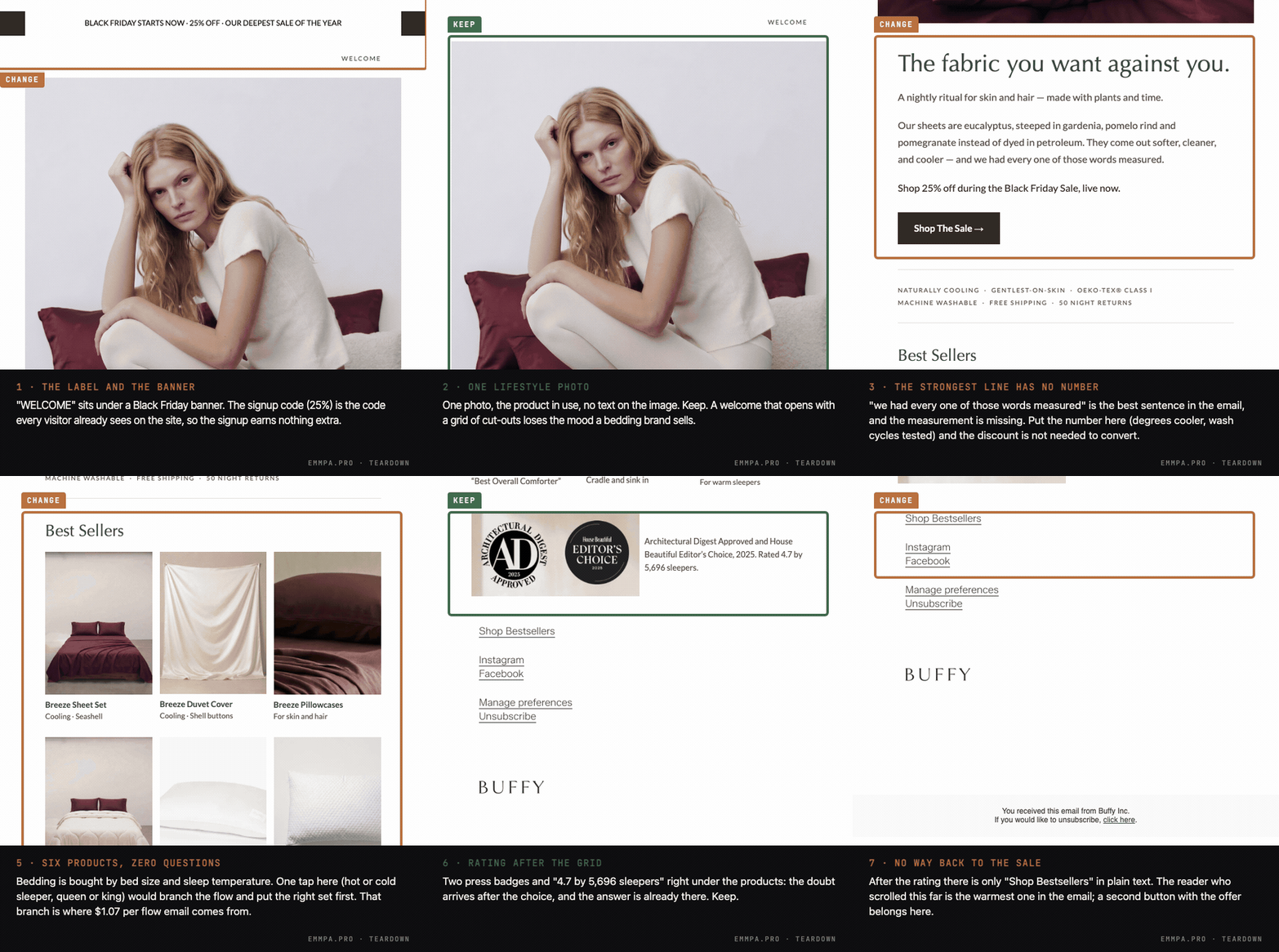
The first email is the welcome flow with the seasonal sale laid over it: a “WELCOME” label under a Black Friday banner, one lifestyle photo, three sentences on eucalyptus fabric (“softer, cleaner, and cooler, and we had every one of those words measured”), a single button, then the trust strip (naturally cooling, OEKO-TEX Class I, machine washable, free shipping, 50-night returns), the 6 best sellers, two press badges (Architectural Digest Approved 2025, House Beautiful Editor’s Choice 2025) and “Rated 4.7 by 5,696 sleepers”. Sender: Buffy, info@buffy.co, sent through Klaviyo.
The second email is almost entirely images. The text version carries only links: the Wiggle pillow 4 times, two sheet sets, the eucalyptus collection, pillows, best sellers. The subject and preview promise a quick bed-builder; the email does not ask a question, it links out.
What they do well
- Speed. The welcome lands within a minute. Most stores in our audits send it 10 to 30 minutes late or not at all when the popup is one tool and the ESP another.
- One offer, stated once. 25% off, one button, no stacking of codes. The seasonal sale and the welcome offer are the same number, so the subscriber never has to choose between two codes.
- Proof above the fold of the grid. Certification, returns window and free shipping sit before the products; the press badges and the review count sit right after. For a considered purchase (sheets and comforters are bought after comparison, like rugs) that order is right.
- Best sellers, not the full catalogue. Six items, each with a three-word reason (Cooling · Seashell, For warm sleepers). A new subscriber can choose in one scroll.
Where they leave money
Scored against our 2026 Klaviyo benchmark for Shopify stores (flows deliver 69% of email revenue, a flow email earns a median $1.07 per recipient against $0.20 for a campaign, popups convert 4.7% of viewers).
- The welcome code is the public code. 25% off is what every visitor gets on the site this week. A welcome offer that is identical to the sitewide sale gives the signup no reason to exist beyond the reminder. During a sale, the welcome flow should either carry something the public sale does not (free pillowcases with a sheet set, early access to the next drop) or skip the offer and sell the fabric. The email already has the better argument in it: “we had every one of those words measured”. That line, with the measurement, would carry a non-discount welcome on its own.
- No question before the grid. Bedding is bought by bed size, by sleep temperature and by fabric feel. The second email’s subject promises a bed builder, then shows links. One tap in the email (Hot sleeper or Cold sleeper, Queen or King) would branch the flow and put the right sheet set first. In the home and kitchen stores we run, flows built on the attributes the buyer compares earn several times the median per recipient; the rug store case is the clearest example.
- Email 2 is images only. With images off, or in a text preview, the second email is a list of links. There is no headline in text, no sentence to read, no reason to click. Apple Mail Privacy Protection inflates opens on this list like any other; clicks are what count, and a click needs a sentence.
- Two emails in the first hour. The second message is a good idea an hour too early. A bed builder makes sense after the welcome offer has had a day to work, not while the first email is still unread. On the accounts we run, the second welcome email goes out at 24 to 48 hours.
- Nothing about the comforter buyer. Buffy’s best-known product is the Cloud comforter (the email itself quotes “Best Overall Comforter”). A subscriber who arrived from a comforter review gets the same sheet-led sequence as everyone else. Browse data would fix that: the welcome branch for someone who looked at a comforter should lead with the comforter.
What we cannot see from the outside: whether the flow branches on the signup source, whether there is a checkout flow behind it, and what the list is sent after the welcome. That is what the 72-hour version of this teardown adds.
The version we would send
Same photo, same products, same badges, same footer. Seven changes, all from the list above. Left is the email as it arrived; right is ours.
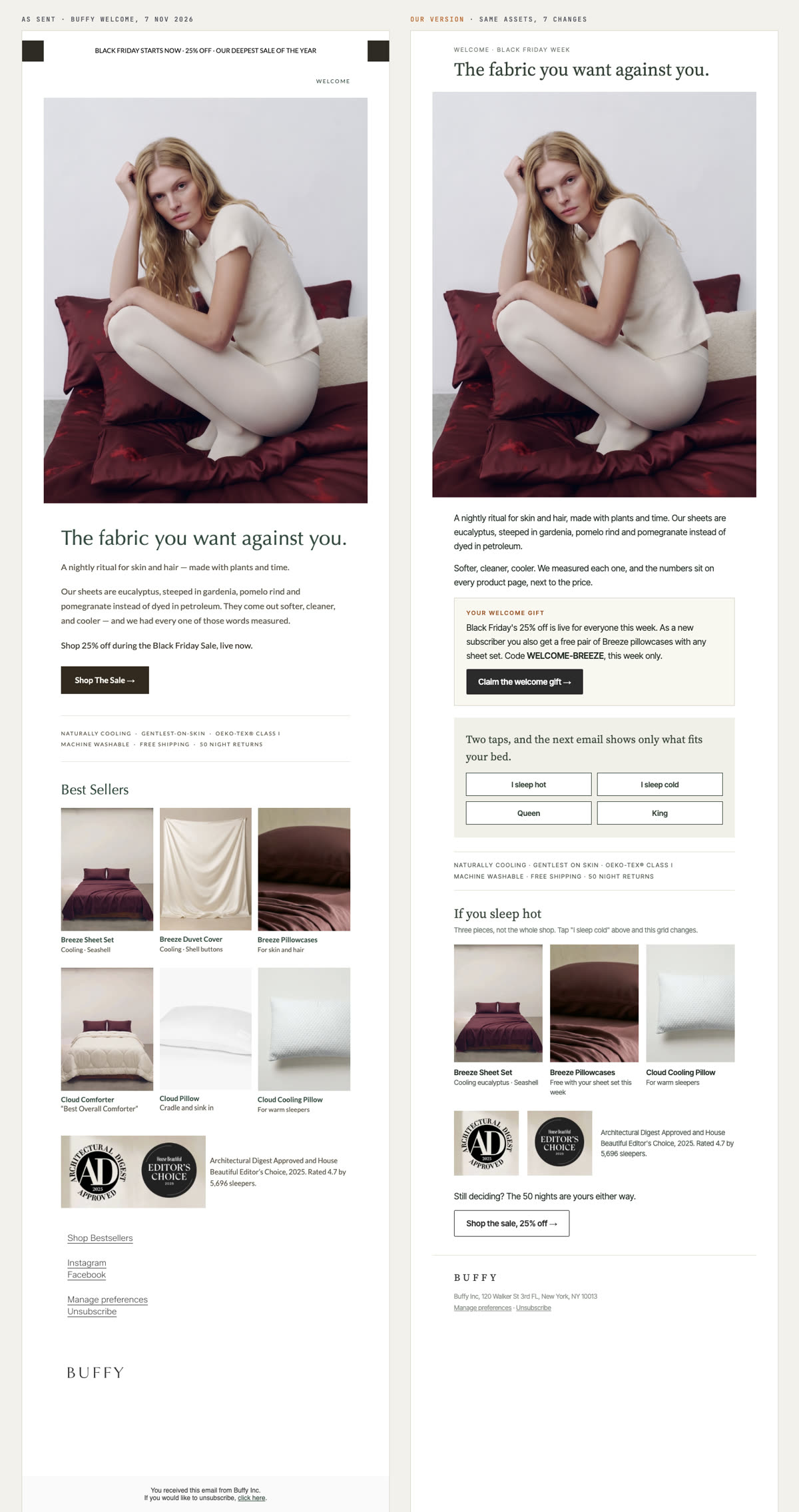
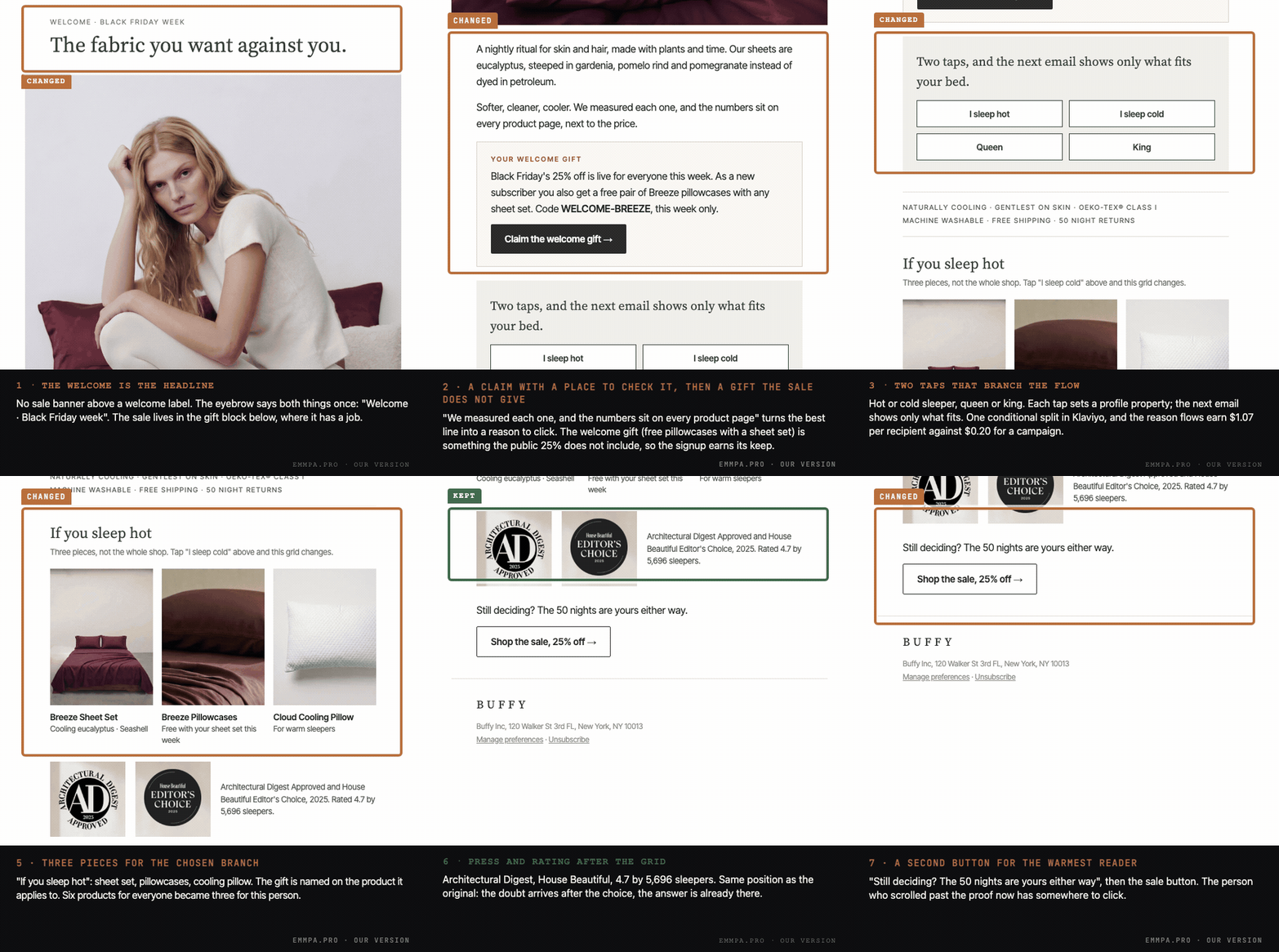
What changed, in the order a reader meets it:
- The welcome is the headline. The sale banner above a welcome label is gone; one eyebrow says “Welcome · Black Friday week” and the sale moves into the gift block, where it has a job.
- The measured claim points somewhere. “We measured each one, and the numbers sit on every product page, next to the price.” The sentence now sends the reader to the proof instead of leaving it as a boast. The numbers themselves have to come from Buffy’s own tests; we did not invent any.
- A welcome gift the public sale does not give. Free Breeze pillowcases with any sheet set, on top of the 25% everyone gets. The offer is our proposal, not Buffy’s; the point is the structure: a signup must earn something the homepage visitor does not.
- Two taps before the grid. Hot or cold sleeper, queen or king. Each tap writes a profile property and the next email shows only what fits. In Klaviyo this is a conditional split on two properties, built in an afternoon.
- Three products for the branch, not six for everyone. “If you sleep hot” with the sheet set, the pillowcases (the gift named on the product it applies to) and the cooling pillow.
- Proof kept exactly where it was. The trust strip before the products, the press badges and the 4.7 from 5,696 sleepers after them.
- A second button for the warmest reader. “Still deciding? The 50 nights are yours either way”, then the sale button. The person who read to the rating now has somewhere to click.
What we would expect from these changes, in the order of confidence: the branch question is the biggest lever (flows built on what the buyer compares earn several times the median per recipient in the stores we run); the gift block changes what the signup is worth; the second button is small and free. We cannot measure Buffy’s result from the outside, so these stay expectations, not claims.
What a Shopify store can copy tonight
- Make sure the welcome lands within a minute. Check the delay on the first email in the flow; if the popup and the ESP are different tools, test the sync with a fresh address.
- Put proof before products: shipping, returns, certification, then the grid, then the reviews count. Three lines, not a page.
- Six products with a three-word reason each, not the whole catalogue.
- During a sale, give the welcome something the public sale does not have, or drop the code and sell the product. Never send the same code twice under two names.
- Ask one question in email 2 (size, temperature, fit) and branch the flow on the answer. It is one conditional split in Klaviyo and it is where the $1.07 per recipient comes from.
Buffy is not a client of EMMPA; everything above is what any subscriber receives, and the redesign is a proposal built from their public email, not work done for them. If you want your own welcome flow read the same way, the free 30-minute audit does it on your account.
The next benchmark, before it is public
Every quarter we re-pull the numbers from the accounts we run and send the summary first to the list, with the teardowns in between. No weekly newsletter, no discounts, unsubscribe in one click.